
Augmented digital graphics that capture everyday emotions

Flower Series

City Series

Nature Series

‘Iberian Spiral’ is an art piece that combines flowers photographed by me in Portugal and Spain. My objective was to assemble a flower montage where the photographs have a location authenticity. In the art piece, the flowers are arranged in the form of a spiral arms surrounding a central white flower serving as the source of all flowers. The background has a similar spiral feel and derives from an AI-generated fractal landscape generated by AI Stable Diffusion 2. The spirals comprise 9 streams, with each stream photographed in either Portugal or Spain. The diversity of color and form of the flowers is apparent, with more than 10 different species represented in the art piece.
I took all the photographs using an iPhone 12 Pro Max. Using Affinity Photo for editing, I resized each photograph to promote effective image segmentation, segmented each photograph to isolate the portrayed flower, exported the resulting photograph on a transparent background, and then combined each of the roughly 50 photographs in the Iberian Spiral piece. In this case, the time to segment a flower from its surroundings was typically 30 minutes or more.
I have chosen to print the art using a substrate of Dibond, which is an aluminum composite material. The process overlays the Dibond with a silver halide print that supports 610 dpi resolution. A satin laminate covers the print for protection, and the entire assembly is placed in a slim white wooden float frame. I have chosen the satin finish to accentuate the visual impact.
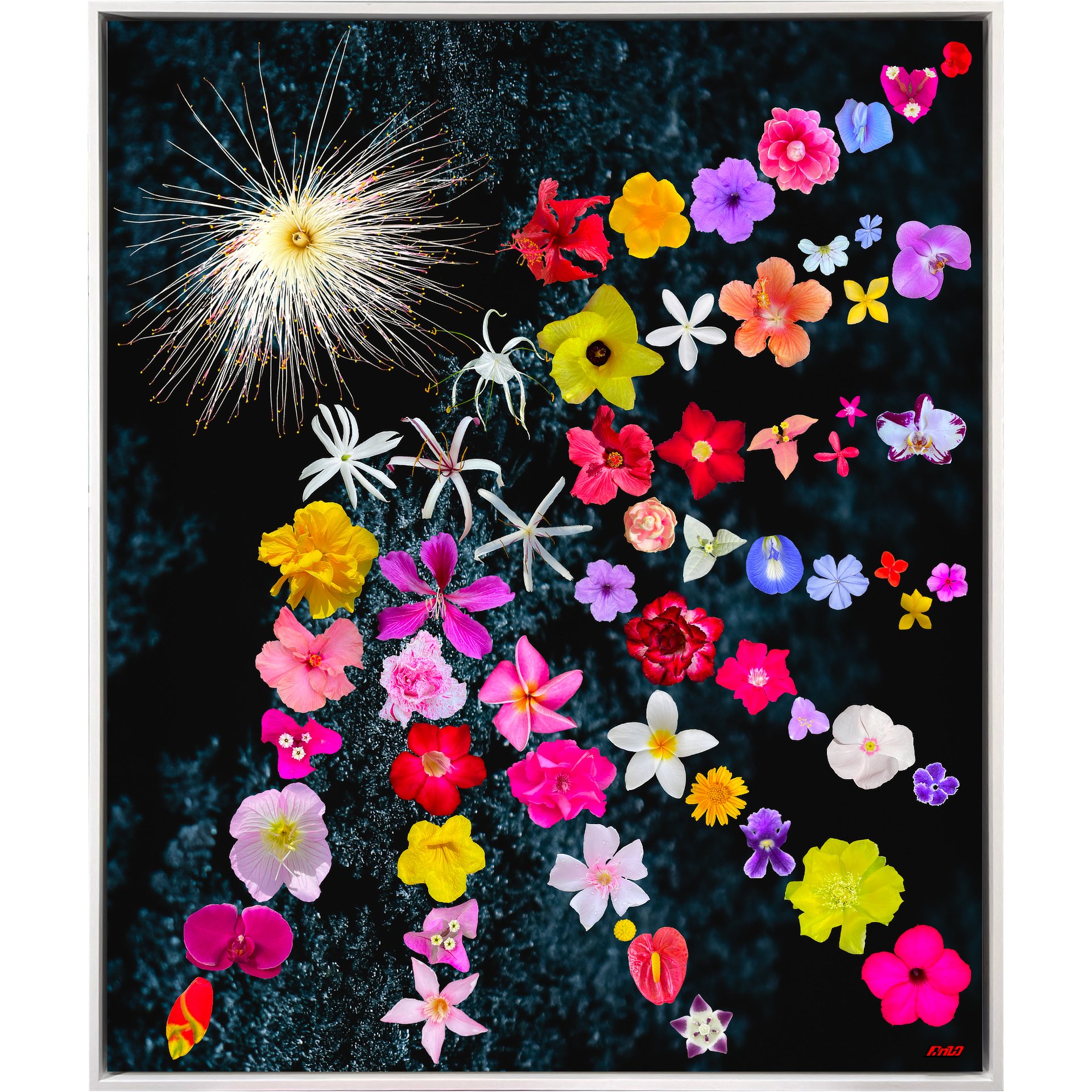
‘Kokomo’ is an art piece that combines flowers photographed by me in Jamaica, Aruba, and Cabo San Lucas. The name derives from The Beach Boys’ song about a fanciful place named Kokomo. The song lyrics mention several Caribbean destinations including Aruba and Jamaica. My objective was to assemble a flower montage where the photographs have a location authenticity. In the art piece, the flowers are arranged in the form of a comet on a textured background representing a dark sky filled with stars and whisps of clouds. The comet’s wide plume comprises 9 streams, with each stream largely photographed a single Caribbean location. Counting from the upper right, I photographed the first 4 streams including the comet head in Jamaica, the next 3 streams in Aruba, and the final 2 streams in Cabo San Lucas. The diversity of color and form of the flowers is apparent, with more than 55 different species represented in the art piece.
I took all the photographs using an iPhone 12 Pro Max. Using Affinity Photo for editing, I resized each photograph to promote effective image segmentation, segmented each photograph to isolate the primary flower, exported the resulting photograph on a transparent background, and then combined each of the roughly 60 photographs in the Kokomo document. The time to segment a flower from its surroundings was typically 30 minutes or more, with some particularly difficult flowers taking more than 10 hours.
I have chosen to print the art using a substrate of Dibond, which is an aluminum composite material. The process overlays the Dibond with a silver halide print that supports 610 dpi resolution. A satin laminate covers the print for protection, and the entire assembly is placed in a slim white wooden float frame. I have chosen the satin finish to accentuate the visual impact.
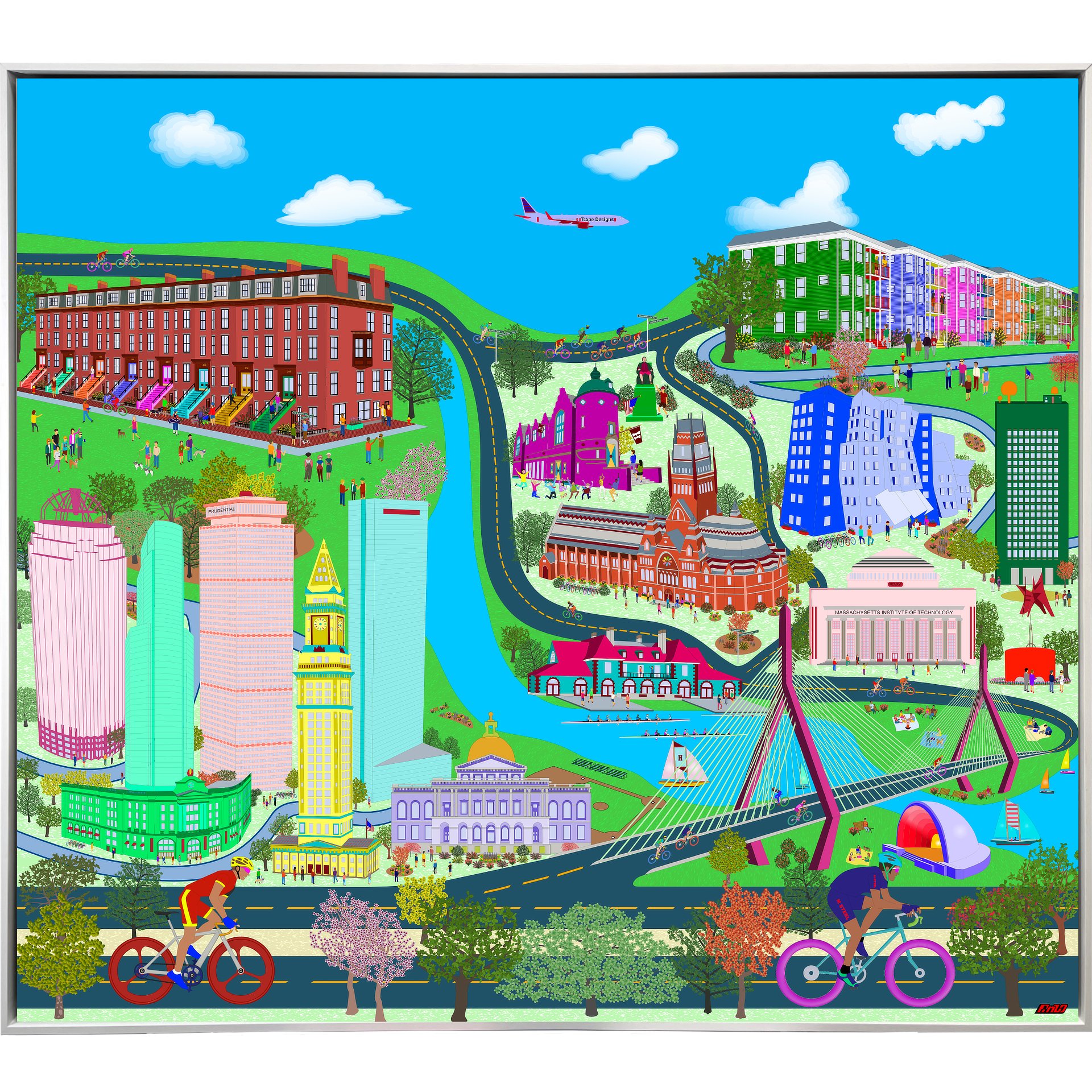
The ‘Boston and Cambridge’ digital art piece highlights the diversity of the namesake cities, with an emphasis on their people and some of their iconic buildings and bridges. My objective is to help the viewer of the piece feel as though they are in the city and enjoying the moment. The piece combines pop art with detailed architectural rendition to produce a novel portrayal of one of America’s great cities. The piece is enhanced by depictions of the people and scenery that differentiate Boston and Cambridge. Production of the graphics requires diligence, and the creation process took me 1000 or more hours to accomplish.
The art piece shows Boston buildings including 111 Huntington, South Station with a proposed tower, the Prudential, the Custom House, the John Hancock Tower (now 200 Clarendon Street), the MA State House, and a depiction of 8 brownstones that are common in Boston’s South End and Back Bay. The edifices in the vicinity of Harvard University include the Boat House, Memorial Hall, the Harvard Lampoon, and the John Harvard statue. The MIT region includes the Great Dome, the Stata building, the Green building, the Chapel, and 5 representative 3 story walkups in Cambridge. The colors in the art piece provide some graphical appeal in a highly stylized version of each of the buildings. The Zakim Bridge connecting Boston to Cambridge is accurately portrayed, including details such as the exact number of stays between the bridge towers. The trees marking the scene include the Live Oak, Apple, Black Maple, Sycamore, Red Maple, Cherry, Ginkgo, Thread-leaf Maple, and Monterey Cypress. A diversity of people and dogs line the streets, as they do in Boston and Cambridge!
I use 2.5D layering with perspective for all the graphics using an extremely time-consuming process. I depict each building from somewhat varying vantage points and with different scales to permit localized graphical scenes. I assemble the building graphics from many different sources that collectively capture the essence of structure and design.
The high-quality graphics are printed on Fujiflex mounted to an aluminum composite substrate. This approach provides exceptional clarity and print durability and offers a suitable mounting surface for the 3D models. Retaining the detailed graphics during printing is only made possible by the 610 dpi resolution of Fujiflex. The art is mounted in a thin white wooden float frame.
‘Many Happy People’ depicts those moments in life filled with unconstrained happiness. We all need to jump for joy, at least metaphorically, as often as possible. I created the art to emphasize the parts of everyone’s life that are the most special. The piece combines high-quality graphics with laser-cut acrylic pieces that outline color segments. The graphics are printed using Fujiflex on Dibond, an aluminum composite material, which together provide exceptional color and durability. The piece uses a ⅛” non-glare acrylic overlay to add additional depth to the appearance, and mounts with an aluminum inset frame with a French cleat. I have chosen a mid-gloss finish to accentuate the visual impact.
Dimensions: Height – 48
Width – 24


The ‘Boston and Cambridge’ digital art piece highlights the diversity of the namesake cities, with an emphasis on their people and some of their iconic buildings and bridges. My objective is to help the viewer of the piece feel as though they are in the city and enjoying the moment. The piece combines pop art, architectural precision, and 3D models to produce a novel portrayal of one of America’s great cities. The piece is enhanced by depictions of the people and scenery that differentiate Boston and Cambridge. Numerous 3D-printed bicycles, one with moving parts, are embedded in the art add a sense of liveliness to the architectural background. I created both the graphical elements and the 3D models of the bicycles to provide an expanded sense of realism. Production of the graphics requires diligence, while the creation of a scalable, miniature bicycle with an operating crank and wheels requires very careful modeling. The combination of detailed graphics and 3D models is unusual, and the creation process took me 1000 or more hours to accomplish.
The art piece shows Boston buildings including 111 Huntington, South Station with a proposed tower, the Prudential, the Custom House, the John Hancock Tower (now 200 Clarendon Street), the MA State House, and a depiction of 8 brownstones that are common in Boston’s South End and Back Bay. The edifices in the vicinity of Harvard University include the Boat House, Memorial Hall, the Harvard Lampoon, and the John Harvard statue. The MIT region includes the Great Dome, the Stata building, the Green building, the Chapel, and 5 representative 3 story walkups in Cambridge. The colors in the art piece provide some graphical appeal in a highly stylized version of each of the buildings. The Zakim Bridge connecting Boston to Cambridge is accurately portrayed, including details such as the exact number of stays between the bridge towers. The trees marking the scene include the Live Oak, Apple, Black Maple, Sycamore, Red Maple, Cherry, Ginkgo, Thread-leaf Maple, and Monterey Cypress. A diversity of people and dogs line the streets, as they do in Boston and Cambridge!
I use 2.5D layering with perspective for all the graphics using an extremely time-consuming process. I depict each building from somewhat varying vantage points and with different scales to permit localized graphical scenes. I assemble the building graphics from many different sources that collectively capture the essence of structure and design.
Each bicycle with moving wheels, cranks, and sprockets has parts that are separately 3D printed using 60-micron layers. Eight of the parts are separately dyed and polished, including the front wheel, the rear wheel, the handlebars, the seat, the pedal with the crank, the pedal without the crank, the rear sprocket, and the frame. The chain is 3D printed in a flexible plastic. When appropriate, the non-moving parts are glued together prior to mounting. Each bicycle with moving parts is assembled and mounted using 13 pieces of stainless-steel hardware.
If present, the bicycles without moving parts are 3D printed on a high-definition, full-color printer that produces the entire bicycle from nylon using a fused deposition process. The 100-micron layer height used during the printing is smoothed with a coating prior to mounting.
The high-quality graphics are printed on Fujiflex mounted to an aluminum composite substrate. This approach provides exceptional clarity and print durability and offers a suitable mounting surface for the 3D models. Retaining the detailed graphics during printing is only made possible by the 610 dpi resolution of Fujiflex. The 47”x42” art is mounted in a thin white wooden float frame.